Straight From the Source

If you told me five years ago that I would be a practicing social worker, I wouldn’t have believed it. Don’t get me wrong, it wasn’t that I didn’t want to become a social worker. Rather, I felt that it would be something that I couldn’t do because of my Autism. To be entirely honest, I took to heart some of the negative stereotypes and misconceptions people have about Autism. I felt like I could never support others because my eye contact is fleeting. From a young age, most kids learn that good eye contact is one of the most important skills for social interaction. My interests can also be rather specific, and I really enjoy sharing about them, but sometimes I have a difficult time telling when others want to change the subject. In all my years receiving Autism-related services, I had not once met a clinician with Autism. Since there were no models, I worried that people must not want a social worker who has Autism. It was during my time in undergrad that I met someone who had similar differences who was pursuing a career in social work. With that person’s support, I came to the realization that I would take a chance on my dreams and become a model for others who might wish to follow suit. I earned my undergraduate degree and applied for a master’s level social work program.
My early career assumption was that I would pursue employment in the realm of immigration or refugee services, but my curiosity got the better of me and I decided to interview at one Autism-related agency. That agency was Milestones Autism Resources. “Milestones serves clients with Autism and I have Autism, maybe this could be a good fit,” is what I told myself. I called Beth Thompson and within a week I had an interview. I arrived far too early than what might be considered professionally appropriate, the dress shirt (that my mother encouraged me to tuck in) was untucked because I found it to be too uncomfortable, and my interview consisted of an abundant amount of oversharing. Yet from the moment I walked through the door to the moment I left, I felt welcomed. I knew then that Milestones was where I wanted to complete my first year internship. I celebrated with my family when Milestones offered me a position as their Graduate Social Work Intern.
Continue reading →
 As I consider making goals, whether for the whole year of 2018 or just for upcoming situations I know will be challenging, I utilize a pattern I learned in my first semester of college. This strategy may be familiar to you too. It’s called making “SMART” goals, which is an acronym that stands for specific, measurable, attainable, realistic, and timely.
Using this strategy has helped me find success in areas where I truly want to make changes or grow personally. In the past when I was not realistic, I would make goals that were far too grandiose which resulted in my giving up easily, and being unable to actually see any progress. Now I concentrate on smaller but attainable changes, and once I reach them I push the goals out further. I also set only one or two goals at a time in order to keep my focus.
For example, I struggle with asking repetitive, anxiety-provoked questions of others. Instead of setting a goal like, “I will stop asking repetitive questions,” I set a SMART goal. Applying the SMART strategy to the goal would look like this:
S (specific): I will reduce my repetitive, anxiety-provoked questions at home. I will enlist the help of a family member to give me cues when needed and keep me accountable to my goal. I will reduce the questions to two times each.
Continue reading →
 Some of my greatest memories are holiday-related. For example, the Christmas of 1982 when Santa placed under our tree a stuffed prairie dog—Prairie Pup. My new special interest quickly became prairie dogs for the next eight years. Prairie Pup and I were inseparable, until I began middle school and Prairie Pup became the first prairie dog to be expelled from the Oakland County Schools. The special education teachers informed my parents, “Your son is too old to be carrying a love-worn prairie dog, desperately needing Rogaine.”
During the holidays, I have experienced meltdowns and stress. When I was seven years old, my Christmas gift was an army outfit, equipped with a toy machine gun, walkie-talkies, and binoculars. After a few days, the trigger on the machine gun broke. My parents did not send it back to the North Pole for repairs but instead returned it to Sears for a new set. The new army set was complete except for one small detail —the binoculars were a different style, a 1940’s design compared to modern. When I saw the new binoculars in the box—the former ones missing—my emotions erupted. I began hitting my head relentlessly, smashing everything in my path. My meltdown lasted ten straight hours; it only ceased after my parents went back to Sears and found my original binoculars.
Continue reading →
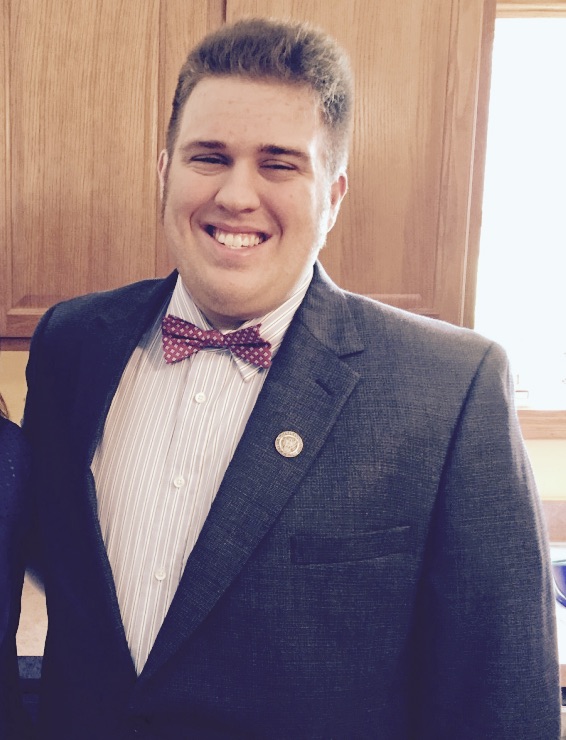 Cory Irwin calls himself an informal humorist.
He loves to make people laugh. He enjoys being an attentive friend. Take the time one of his friends was in the hospital. Knowing she loved awards shows, Cory live texted the entire Oscars ceremony for her.
“I do not tolerate when people are sad,” says the 24-year-old Ohio native and recent Walsh University graduate. “You will not be unhappy around me.”
Thanks to an amazing support system and loving family, Cory is applying what he has learned with Milestones (social development, work skills, job hunting) to school, during his internship at The Jewish Federation of Cleveland and in his relationships with friends and co-workers.
“This whole interchanging web of support has helped me through the years,” he says. “I had a lot of intervention in public school as well as coaching from Milestones. And of course, my support from family.”
Continue reading →
Newer posts →
Newer Entries »