


Straight From the Source
Straight from the Source – 2018 Conference Speaker, Raesin Caine
T-minus two weeks until #MNAC2018 and we could not be MORE excited about all the insightful, informative sessions this year! Milestones is especially thrilled about the outstanding line-up of self-advocates presenting, one being Raesin Caine, MS. Raesin is a self-proclaimed nerd for science, the arts, and learning new things whenever she can. Diagnosed just last year with autism, Raesin celebrated when she received the news. Since her diagnosis, Raesin has made it a personal goal to change the way people think about autism by counteracting negative perspectives of the disorder when she encounters them.
“If I had my way, I’d do away with the charity walks, puzzle pieces, and tragic language, and insist on reframing autism in a way that promotes confidence, ownership, and celebration (I’m imagining the enthusiasm you’d find at a drag ball or marching band extravaganza.)”
What initially got you interested in the Milestones Conference? Can you describe your first 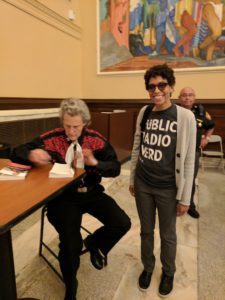 conference experience and why you wanted to come back as a speaker?
“Admittedly, I was starstruck by Temple Grandin, who has been one of my heroes since I first read about her back in the nineties in the book, An Anthroplogist on Mars. I was also curious about what I could learn at an autism conference since I’d never attended one before.
I had a lot to say on my feedback form for last year’s conference. I learned important things at some of the workshops, met great people, and absolutely loved Dr. Grandin’s talk. At the same time, I felt disappointed by the number of sessions offered by self-advocates. It’s important for self-advocates to see ourselves throughout the programming and for neurotypical people to listen to our perspectives, so that’s why I decided to submit a presentation proposal.
I spoke up in a couple of workshops during the question-and-answer sessions last year and a number of people pulled me aside to ask me more about my experience. Their reactions were a good reminder that parents, sponsors, and other attendees need to hear from self-advocates especially because we tend to be heavily outnumbered at autism conferences. I am certain autism conferences would proceed quite differently if self-advocates developed the full conference schedule, gave all the talks, and provided all the sponsorship.”
Continue reading →
Straight from the Source – Carly Nelson
 As a speech-language pathologist in training, I recognize the importance of self-advocacy. As an Autistic* person and sister of another Autistic adult, I have seen firsthand how safety and happiness depend on it. I spent years watching my brother come home from school hurt, angry, and misunderstood. His self-advocacy, rather than being cherished and honed, was often ignored or even punished. The trauma he endured in these experiences, and my experiences learning to advocate for myself, while riddled with anxiety, have shaped my appreciation of the critical need to honor and promote self-advocacy.
My brother’s diagnostic process followed the usual timeline. My mother and the pediatrician noticed early developmental delays in areas of mobility and speech. He got his diagnosis by age 3 and was enrolled in early intervention. After school each day, I’d sit on the other side of the mirrored-window and watch various professionals work with him. My journey with autism has differed widely from the understood norm, but is not at all uncommon. In kindergarten, I was reading chapter books and already performing in the top of my class. My mother’s ongoing lament throughout my life was that I could be “so good at school, yet so difficult at home.” As it turns out, this holding-it-together-in-public-and-melting-down-at-home routine is common in people whose autism doesn’t present naturally. We have managed to appear “okay” when complete loss of control feels too unsafe. But doing so taxes our nervous systems heavily such that we pay for it later.
For most of my early life, it didn’t occur to anyone, myself included, that I might also be on the spectrum. At school, I was quiet, but quick to learn. At home, I was an unruly brat. My brother was probably the first to realize, though not consciously. We bonded with one another more deeply than with anyone else in this world. During family parties, we have always found where the other was hiding (or crying if we got too overwhelmed) and quietly kept each other company, an unspoken tradition of camaraderie. We would pick up each other’s stims and lift the mattress for each other to go under when we were struggling.
Newer Entries »