Blog
One highlight of our conference each year is our Straight from the Source series, a grouping of panels featuring individuals with autism and those closest to them. This year, we held an Autism at Work panel, a session for adults on the spectrum to share their experiences of joining and being a part of the workforce. During this panel, attendees got to meet Evan Spencer, Amy Kleinman, Angel Russo, and Tim Hughes, self-advocates with a variety of perspectives gained from employment. Evan, Amy, Angel, and Tim were kind enough to sit down with Milestones after their panel to share a little bit about the topics discussed and why they wanted to get involved.
Thanks so much for taking some time to talk to us today! Would you mind telling us how you first heard of Milestones?
Evan: My mom runs a support group that works closely with Milestones. I came my first year to the conference kind
of nervous, to see what was here for myself. I always thought it would be people my mom’s age who are working for individuals with autism, but then I saw it was also for individuals and that’s what sold me on coming back.
Amy: I’ve known about Milestones for I don’t know how many years. My mother and I had talked about coming to the conference for years; we have gone to Beth Thompson for some
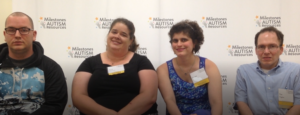
help when we needed it. And finally last year, we were just like ‘you know what, we’re going to get scholarshipped and we’re going to go!’ Then this year, Beth asked me to speak, so we’re here again. And hopefully next year too!
Angel: Haley Dunn who is with Milestones, I knew her for a long time so she asked me to come speak.
Continue reading →
Couldn’t come to the conference? No worries, we’ll fill you in. Four of Milestones’ own presented at the conference this year on a variety of topics:
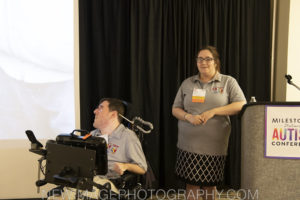 Milestones Administrative Assistant and self-advocate Molly D. Dann, presented two workshops, one with the Cuyahoga County’s Good Life Ambassadors program where safety in the community was discussed, and another sensory-focused workshop with two other self-advocates wherein panelists shared their personal experiences coping with sensory issues.
Beth Thompson, Program Director, did a conversational session with Carl Brass, Executive Director of Monarch LifeWorks, on how to make ethical decisions when working with adults on the autism spectrum. They discussed when how federal rulings like the Olmstead Act impact providers when weighing decisions about protecting the adults they serve and letting them have their own autonomy in decision-making.
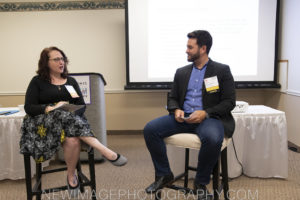 Milestones Early Intervention/School Age Coordinator Nathan Morgan did a total of three workshops! He started the conference out with a session sharing tips and suggestions for families to follow after receiving a new diagnosis of autism – Nathan reviewed common evidence-based therapies, how to access them, and how to work with school districts. Nathan then served as a moderator on the Straight from the Source: Autism at Work panel, where he led a discussion with four other adults with ASD about their path to employment. Nathan and Molly then closed the conference with another staff advocate and Milestones volunteer, Grace Blatt, where they shared their practical strategies for dealing with common sensory issues.
Continue reading →
Summer is finally here. Bring on the sunshine! While summer has its perks, the season can also bring new challenges for families whose loved ones must adjust to a new schedule.
Without the structure of school and other programs that take place throughout the rest of the year, families can be left scrambling to fill in unstructured time for their child. Fortunately, there are many ways to make the most of this time that can be beneficial for everyone involved. Check out the following suggestions from Milestones Early Intervention/School Age Coordinator Nathan Morgan:
Schedule your day. Using visual schedules can be helpful for anyone whether they are neurotypical or on the autism spectrum. Hang a colorful calendar showing when any special activities are planned. Update any written or picture schedules to include time slots for the unstructured time. Break activities into smaller tasks as appropriate. For tips on how to create schedules and visual supports, checkout the Milestones Visual Supports toolkit.
For example:




-Wake Up
-Play at the Park
-Eat Breakfast
-Eat Lunch
Explore new hobbies/activities. The free time during summer break can provide a great opportunity to explore new interests with your child. Baking muffins or other treats can be a great activity to spend time with your child, develop daily living skills, and also has a yummy final result! Baking has plenty of steps which can be made into a visual schedule and can be broken down into tasks which are developmentally appropriate for your child.
Continue reading →
“Would you be willing to intern a young adult on the spectrum?” That was the question posed by my HR department. Milestones Autism Resources had some clients with an interest in art and as Director of the Federation’s Cleveland Israel Arts Connection, I was asked if I had an appropriate project for a six-month internship.
At the time, I didn’t know much about persons with autism, but I was willing to learn. Besides, I had a project on my wish list that I had never gotten around to. I thought it would be a good experience for me personally, and a mitzvah as well. Then I met Cory Irwin and the internship became so much more.
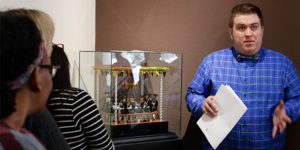
Cory presenting a piece at the Jewish Federation of Cleveland
As soon as I met Cory, any outdated and uninformed notion I had of a person with autism completely dissolved. Cory is a 24-year-old college graduate who earned a B.A. in museum studies from Walsh University and is currently pursuing a master’s degree in humanities from John Carroll–an amazing accomplishment for any individual.
As I explained the project to Cory, cataloguing artworks in the Federation’s permanent collection, it became apparent that Cory had a vast, almost encyclopedic, knowledge of visual art and art history. He was able to interpret artworks in highly sophisticated ways. And research? I have never met anyone as resourceful as Cory. If he couldn’t find information online, he would call libraries. He asked intelligent questions and contacted artists directly for insight into their works.
The final catalog contains detailed essays of over 20 artworks. Each essay explores the background of the artist, artistic influences, and an interpretation of the work. Cory compiled information from numerous sources and authored each of the essays. I quickly ran out of superlatives when describing the quality of his work. Next month, Cory will present his catalog to Federation staff and offer a tour of selected works – works that we pass by every day will now have added meaning. The catalog will also be available to visitors to the Federation’s Jack, Joseph and Morton Mandel Building.
But even more than the final catalog, Cory’s presence in the office will have a lasting effect. He was a contributing staff member, attending staff meetings, group outings, and holiday celebrations. Many of my colleagues commented often on his friendliness, outgoing nature, and his passion for his family, faith, and comic books. Cory enjoyed learning from others and was a willing teacher, often sharing his expertise on a variety of topics.
Continue reading →
Are you one of the many parents raising a child with autism alongside a child who is not on the spectrum? We understand the complex challenges that arise in your situation, so we wanted to make sure there was a session just for you at our conference next month.
 Join Allison Benedict from the Cleveland Clinic Center for Autism on Friday, June 15th at 12:15pm for the session, “Addressing the Needs of Neurotypical Siblings”. Bringing a breadth of knowledge gained from being a licensed early intervention specialist and board certified behavior analyst, Allison will discuss research on negative and positive effects of having a sibling with ASD, evidence-based ways to have a better outcome, and how to educate neurotypical siblings on the diagnosis of autism, while supporting them for better adjustment.
What are the most commonly asked questions that come from parents concerned about the impact of an ASD diagnosis on their neurotypical child(ren)?
One of the first questions that parents ask is how to explain the diagnosis to their neurotypical children. They also want to know how to find a balance between supporting the needs of their child with autism while also being able to carve out time out with their neurotypical child(ren).
What is one of the positive effects of having a sibling with ASD?
There are many positive effects including greater empathy, compassion, understanding, kindness, and more positive interactions with others. Additionally, siblings tend to have higher self-esteem.
Continue reading →
← Older posts Newer posts →
« Older EntriesNewer Entries »